


Do you sell on Shopify and want to add a nice-looking catalog that actually makes people stop, look, and buy? Thousands of Shopify store owners have great products and a well-designed store. They often do not know how to connect everything on the product page in a way that looks perfect and actually helps increase sales.
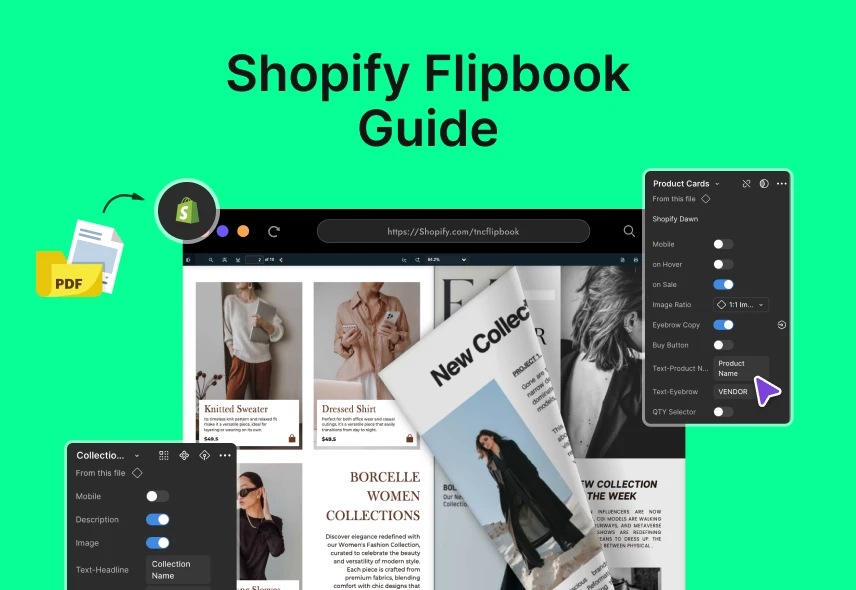
Adding an interactive flipbook to your Shopify store closes that gap fast. You don’t need to send customers to another link or ask them to download a file. Now you can show a beautiful page-turning digital catalog directly on your Shopify product page. In this guide, we will explain why adding a digital catalog using FlipBook can improve your Shopify product page. We will also walk you through simple step-by-step instructions on how to install FlipBook, set it up, and add your digital catalog to your Shopify store using FlipBook. Now, let’s get into the details and explore it.
Why Product Pages with Catalogs Convert Better?
Here is a simple truth about online shopping. People buy what they understand. When a customer lands on your product page and sees only a few images and a short description, they have questions. When questions are not answered, people leave without buying.
A digital catalog embedded on your product page answers those questions before they are even asked. It shows the full product range, size charts, usage guides, material details, care instructions, and even lifestyle imagery.
- Buyers spend more time on your page, which signals trust to search engines
- Customers understand your product better and feel more confident buying it
- You reduce return rates because buyers know exactly what they are getting
- Your store looks more professional and premium compared to competitors
- You can showcase an entire product line from a single product page
Step by Step: How to Add a Digital Catalogue Using FlipBook to Your Shopify Product Page
In this guide, we will show you how to add a digital catalogue using a FlipBook to your Shopify store. There are many apps available to add FlipBook to your Shopify store. Among all of them, the most convenient and feature-rich option is TNC PDF FlipBook. It allows you to convert your PDF into a page-flipping digital flipbook that customers can flip through just like a real book.
Part 1: How to Download and Install FlipBook
Step 1. Open your browser and go to the Shopify App Store.
Step 2. In the search bar, type “TNC PDF FlipBook” and press Enter.
Step 3. Click on the app from the search results, then simply press the “Install” button to add it to your store.
Step 4. You will be asked to connect the app to your Shopify store. Log in to your store if needed and confirm the connection.
Part 2: How to Set Up Your First FlipBook
Step 1. From your dashboard, click on “Create FlipBook” or go to the PDF to FlipBook tab.
Step 2. Give your FlipBook a title (example: “Spring 2025 Catalogue”).
Step 3. Upload your PDF file. Make sure your PDF has clear text and high-quality images for the best result.
Step 4. Wait for the app to convert your PDF into an interactive FlipBook. This takes just a few seconds.
Step 5. Once converted, go to the Appearance tab to customize how it looks:
- Pick your brand colors for background and text
- Add your logo
- Choose a background image if you want
- Select one of the 6 color themes available
- Pick your preferred icon size (small, medium, or large)
Step 6. In the Toolbar settings, choose which tools to show or hide, for example, Download, Print, Share, Zoom, and Search.
Step 7. Click Save. Your FlipBook is now ready.
Tip: If you already have PDF links on your store, the app’s Shopify Wizard will automatically find and convert all of them into FlipBooks in one go, no need to upload them one by one.
Part 3: How to Add Your FlipBook to Your Shopify Store
Once your FlipBook is ready, adding it to your store is simple. TNC PDF FlipBook gives you 6 methods to choose from. Each method works differently depending on where and how you want to show the catalogue. Pick the one that works best for you.
Method 1: Embed (Show FlipBook Directly on the Page)
The FlipBook appears open and ready to read right on the page. No clicking needed.
In Display Settings, select Embed. Then adjust:
- Width and Height: set how big the FlipBook looks on screen (default: 100% wide, 600px tall).
- Responsive Height: set a smaller height for mobile phones (default: 400px).
- Full Width: turn on to stretch the FlipBook across the full browser width.
- Enable Fullscreen Link: adds a link that opens the FlipBook in full screen. You can place it above or below and choose if it opens as a pop-up or a new tab.
- Grid Columns: If you add multiple FlipBook URLs, this arranges them in a neat side-by-side grid.
- Hit Save, and you are done.
Method 2: Plain Link (A Clickable Link That Opens the FlipBook)
A simple text link appears on your page. Clicking it takes the visitor to the FlipBook. In Display Settings, select Plain Link. Then set:
- Link Text: what the link says, e.g., “View Our Catalogue.”
- Link Target: same tab or new tab
- Link Color and Hover Color: match your store’s style
- Alignment: left, center, or right
- Hit Save.
Method 3: Popup Link (Opens FlipBook as a Popup)
A text link appears on the page. When clicked, the FlipBook opens as a pop-up, and the visitor stays on the same page. In Display Settings, select Popup Link. Configure the same Link Settings as Method 2. Hit Save.
Method 4: Embed Using iFrame Code
The FlipBook appears fully open on the page, same as Method 1, but using code instead of the App Block.
- Copy the iFrame code from your FlipBook dashboard.
- Paste it into your page using the HTML Editor or Custom Liquid.
- Save and publish. The FlipBook will appear embedded on the page.
Method 5: Popup Link Using HTML Code
A clickable link opens the FlipBook as a pop-up, the same as Method 3, but using code.
- Copy the HTML code from your FlipBook dashboard.
- The code contains class=”pdfflipbook-popup”, keep this as it is. This is what makes it open as a pop-up.
- Paste it into your page using the HTML Editor or Custom Liquid.
- Save and publish. Visitors will see a link that opens the FlipBook as a pop-up.
Method 6: Plain Link Using HTML Code
A clickable link opens the FlipBook as a regular link, the same as Method 2, but using code.
- Copy the HTML code from your FlipBook dashboard.
- Find class=”pdfflipbook-popup” in the code and delete it. This turns it into a plain link instead of a pop-up.
- Paste the updated code into your page using the HTML Editor or Custom Liquid.
- Save and publish. Visitors will see a link that opens the FlipBook directly.
What Kind of Catalogs Work Best on Product Pages?
Not sure what to upload? Here are the most effective types of content that Shopify store owners are turning into FlipBook.
- Full product catalogs showing your complete range
- Seasonal lookbooks for fashion, home decor, or lifestyle brands
- Size and fit guides for apparel, footwear, or furniture
- Instruction manuals and how-to guides for technical products
- Wholesale or bulk pricing sheets for B2B Shopify stores
- Brand story and about us booklets that build an emotional connection
- Ingredient or specification sheets for health, beauty, or food products
Real Results Store Owners Are Seeing
Shopify store owners in fashion, home goods, and B2B are seeing clear improvements after adding FlipBook catalogs to their product pages. Buyers are staying longer on product pages. Support teams are receiving fewer “can you send me your catalog” emails. Most importantly, the add to cart rate is going up because customers feel fully informed and ready to buy.
One furniture store owner added a digital catalog using FlipBook to their top 10 product pages and saw people spend over 4 more minutes on those pages. Within the first 30 days, the sales from those pages increased noticeably.
What Makes FlipBook a Smart Choice
FlipBook gives you complete control over how your catalog looks and feels. Choose from six beautiful theme colors, customize your background, adjust toolbar positions, pick your icon size, and even embed your flipbook as a pop-up or a shareable link. Everything is designed to match your brand and give your store a professional finish.
Password-protected PDFs, clickable links, and fillable forms all work smoothly inside the flipbook. You can use it for product catalogs, brochures, lookbooks, and more, and share them on your website, social media, or email campaigns.
Final Thoughts
If your product page feels basic or is not converting well, adding a digital catalog using FlipBook can be a smart upgrade. It is simple, effective, and helps improve how customers interact with your store. When customers can flip through your full catalog and easily find all the details they need, they understand your products better and are more ready to buy.
Customers don’t just buy products, they want clarity before making a decision. When everything is clear, they make faster decisions. So don’t wait for visitors to hesitate. Give them a smooth and easy buying experience that naturally guides them to a purchase.
Frequently Asked Questions
Do I need coding knowledge to add a FlipBook to my Shopify store?
No. TNC PDF FlipBook gives you a simple embed code that you paste into your product description. That is all it takes. No developer needed.
Will the flipbook slow down my product page?
No. TNC PDF FlipBook uses lightweight, optimized code so your page speed is not affected. Fast loading pages are important for SEO and conversions, and the app is designed with that in mind.
Can I add the FlipBook to multiple product pages?
Absolutely. You can create as many flipbooks as you need and add them to any product page on your store. Different products can have different catalogs for a more targeted buyer experience.
What file format do I need to upload?
Just a PDF. Any standard PDF file works. You can create your catalog in Canva, Adobe InDesign, PowerPoint, or any design tool and export it as a PDF before uploading to TNC PDF FlipBook.
Does it work on mobile devices?
Yes. FlipBook is fully responsive and works smoothly on smartphones and tablets. Since a large portion of Shopify shoppers browse on mobile, this is essential, and the app handles it beautifully.







0 Comments